



When United Medical Center in Washington, D.C., received their COVID-19 vaccine doses in December 2020, Clinical Nurse Manager Patricia Cummings was asked to assist in administering them. As one of two nurses performing inoculations, she seized the opportunity to speak in-depth with many of her hospital’s physicians. In seeking their advice, they explained how the benefits, most notably an efficacy rate of up to 95 percent, outweighed the risks.
Not only was it important to do the research as a nurse leader, Cummings understood the hesitancy about the vaccine among Black and minority communities in the U.S. In the Tuskegee Syphilis Study in 1932, Black men with and without syphilis were enrolled in a government-backed research program without informed consent. They were promised free medical care, but they did not receive treatment, even after penicillin was found to cure syphilis in the mid-1940s. In the case of Henrietta Lacks, her cancer cells were used for medical research without her or her family’s knowledge, and she never received any financial compensation. The cells doctors had taken and cultured were named HeLa cells, after the patient, and went on to change the course of medical research.
“In the African American and Caribbean American communities, there is a lot of skepticism about the vaccine for a variety of reasons,” says Cummings, a Walden Master of Science in Nursing (MSN) student who immigrated from Guyana 21 years ago. “Some of it is distrust in the medical system, and there is also concern about how quickly the vaccine was created.”
Learning about the effectiveness of the COVID-19 vaccines was especially important to Cummings. As of February 2021, the Centers for Disease Control and Prevention (CDC) reports Black people are 2.9 times more likely to be hospitalized and 1.9 times more likely to die from COVID-19 as compared to white Americans. Hispanics are 3.2 times more likely to be hospitalized and 2.3 times more likely to die. Native Americans are 3.7 times more likely to be hospitalized and 2.4 times more likely to die.
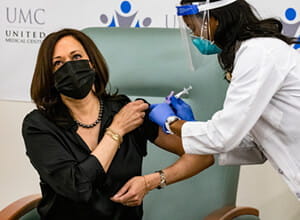
(Photo by Samuel Corum/Getty Images)
After vaccinating her hospital’s CEO and most of their executives, she was excited to learn she’d have the opportunity to vaccinate Kamala Harris, the soon-to-be 49th vice president of the United States and first woman and person of color to serve in that role. Vaccinating Harris and her husband, Doug Emhoff, on December 29, 2020 gave Cummings a larger platform to educate minority communities on the vaccines’ effectiveness.
“It was such an honor, and she was very gracious and calming,” says Cummings. “My friends and colleagues said they chose the right nurse because I was trying to get the message out about getting vaccinated. I’m really grateful that this experience amplified what I was already trying to do.”
Cummings has used her newfound platform to create awareness about the safety and efficacy of the vaccine on the news through such outlets as NBC4 Washington, Healthline and NurseJournal. She's worked to reach Black communities through interviews with The Washington Informer and Black Press USA. She’s even participated in unique speaking opportunities with organizations like the Embassy of Guyana.
“I have two children, and, being a front-line worker, I’m very hands on with COVID-positive patients,” says Cummings. “If there’s an option to protect myself, I’d rather take it.”
A fall 2020 report from UnidosUS, the NAACP and COVID Collaborative shows just 18 percent of Black Americans and 40 percent of Latinx Americans say they trust the COVID-19 vaccines’ efficacy.
“I’m trying to persuade some of my own relatives to take the vaccine,” says Cummings. “I am using my voice and experience to try and shed some light and regain trust within minority populations. I’ve found that people are open to changing their minds after hearing the facts. I keep abreast of all of the research, and education is really helping.”
Cummings is enrolled in Walden’s Nurse Executive specialization in the MSN program because she wants to play a bigger role in shared governance and decision making in her hospital. It has already helped her take a strong leadership role during the COVID-19 pandemic. She’s put together her learnings about leading through mentorship and empowerment as she motivates others to embrace positive health behaviors.
“Everything that I’ve learned so far at Walden has truly prepared me for the opportunity to educate others on the COVID-19 vaccine,” says Cummings. “What I’m learning now is really useful as we’re talking about being a thought leader and leading voice to promote positive social change.”