


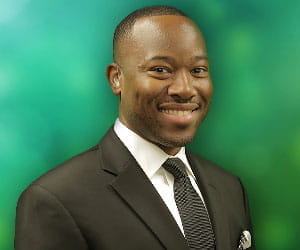
“At the age of two, I contracted bacterial meningitis and the doctors didn’t think I would survive,” recalls Ernest Garrett III, a Walden University PhD in Management student. “As we were leaving the hospital, I’m told my dad dropped his keys and noticed I had no reaction. Sure enough, my hearing was compromised as a result of the medicine I was given to treat meningitis.”
While it was a bittersweet moment for Garrett’s parents, their son’s loss of hearing did not alter their expectations for his success in life.
“My parents wanted the best for me and made sure they did everything in their power to give me an education.”
In second grade, his parents decided to mainstream him, which is when a student is placed into a general classroom with special education services as opposed to being placed in a special education classroom. As the only deaf student, his teacher had a special microphone that transcribed her words into a device he wore.
“I was determined to make it a good school year, despite being regarded as disabled. In fact, my experiences were just as accessible as others.”
It wasn’t until middle school that Garrett discovered what a sign language interpreter was and how one could be useful in the classroom. While the school discussed his individualized education program (IEP) with him and his parents, he was offered an interpreter. Initially, Garrett declined because he had never needed one. His parents, however, thought differently, and Garrett began eighth grade with an interpreter.
“My parents’ decision changed the course of my life.”
At first, Garrett recalls being embarrassed and ashamed, but he quickly came to understand and appreciate the value of having an interpreter.
“It’s about equal access in society, and I never forgot that.”
Garrett went on to earn his associate and two bachelor’s degrees from the University of Arkansas at Little Rock and two master’s degrees from Gallaudet University.
As a licensed social worker, he has advocated for the deaf and hard of hearing community. He became president of the National Black Deaf Advocates organization, which supports thousands of black deaf and hard of hearing people in the United States. He then transitioned into management and leadership at a state agency, the Missouri Commission for the Deaf and Hard of Hearing, and went on to serve as superintendent for three years at the Missouri School for the Deaf.
“I was the first black and first deaf superintendent, and I feel confident in having led the school in a better direction as a result of the strategic plan I developed and put into action.”
Returning to his nonprofit roots, Garrett is now executive director of the Deaf Empowerment Awareness Foundation (DEAF, Inc.). It’s an organization that provides services for the deaf and hard of hearing, hearing individuals, and the community as a whole in the St. Louis metro area to ensure effective communication and promote cultural awareness.
“Our message at DEAF, Inc. is simple: Deaf people can do anything.”
Garrett’s dissertation for his PhD in Management with a specialization in Leadership and Organizational Change includes that same message in relation to diversity and inclusion in the workplace.
“People with disabilities continue to face barriers and challenges to employment opportunities. Not enough is known about the hiring practices of leaders within business cultures and how this may impact the underrepresentation of people with disabilities in positions of leadership,” says Garrett.
He also underscores the importance of self-advocating, specifically for people with disabilities.
“Walden University takes its responsibility seriously to make sure that its curriculum is accessible,” says Garrett. “I’ve also provided essential feedback because graduate students need quality interpreters who are not only certified but hold at least a master’s degree. Those of us pursuing doctoral degrees need a competent interpreter that understands the language of research. I want to confidently defend my dissertation with an interpreter who can follow and keep up.”
Garrett also highlights the existence of services that provide sign language interpreters that can deliver quality interpreting at an appropriate level that is also culturally affirmative and linguistically accessible.
“It’s my personal mission to help others in deaf, black, and all communities have equal access and contribute in meaningful ways to the greater society.”