
View our EdD Early Childhood specialization completion requirements
Minimum degree requirements:
60 quarter credits
- Core courses (50 cr.)
- Capstone (10 cr.)
Minimum degree requirements:
60 quarter credits
Courses
In the EdD Early Childhood Education specialization, you’ll build skills and progress toward your final capstone project in every course.
Disclaimers: Walden students have up to 8 years to complete their doctoral program unless they petition for an extension.
In general, students are continuously registered in the dissertation/doctoral study course until they complete their capstone project and it is approved. This usually takes longer than the minimum required terms in the dissertation/doctoral study course shell.
To complete a doctoral dissertation, students must obtain the academic approval of several independent evaluators including their committee, the University Research Reviewer, and the Institutional Review Board; pass the Form and Style Review; gain approval at the oral defense stage; and gain final approval by the Chief Academic Officer. Students must also publish their dissertation on ProQuest before their degree is conferred. Learn more about the dissertation process in the Dissertation Guidebook.
For a personalized estimate of the number of your transfer credits that Walden would accept, call an Enrollment Specialist at 844-937-8785.
Courses
PhD completion program courses help you return to doctoral work, match with an advisor, and stay on track to finishing your dissertation.
Disclaimers: Walden students have up to 8 years to complete their doctoral program unless they petition for an extension.
In general, students are continuously registered in the dissertation/doctoral study course until they complete their capstone project and it is approved. This usually takes longer than the minimum required terms in the dissertation/doctoral study course shell.
To complete a doctoral dissertation, students must obtain the academic approval of several independent evaluators including their committee, the University Research Reviewer, and the Institutional Review Board; pass the Form and Style Review; gain approval at the oral defense stage; and gain final approval by the Chief Academic Officer. Students must also publish their dissertation on ProQuest before their degree is conferred. Learn more about the dissertation process in the Dissertation Guidebook.
For a personalized estimate of the number of your transfer credits that Walden would accept, call an Enrollment Specialist at 844-937-8785.
Courses
Develop the skills and confidence you need to tackle complex managerial challenges, contribute new knowledge, or teach at the graduate level.
Courses
Develop the skills and confidence needed for complex managerial challenges and research with Walden’s ACBSP-accredited PhD program.
Discover career opportunities in your area that match your interests.
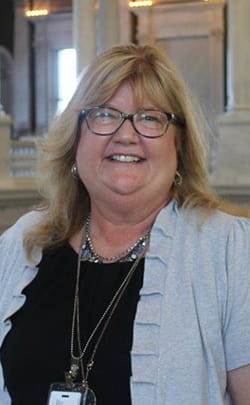
Longtime New Jersey teacher Teresa St. Angelo is stepping into a new role: teacher-in-residence at the Library of Congress for the 2016–2017 school year. It’s the perfect position for her, she says. “I am always looking for fresh ideas. I never want to stop learning.”
St. Angelo plans to mine the library’s extensive assets—which include books, photos, song sheets, sports ephemera, and short videos on subjects ranging from early explorers in America to science and invention—to build innovative, exciting lessons for teachers across the U.S. “I hope to show how Library of Congress artifacts can enhance students’ education. Primary sources help challenge students’ opinions and knowledge, and help them accept new ideas.”
Everything she plans to do stems from her own work to constantly refresh her lessons over the years. Since becoming a teacher in 1986, St. Angelo has never stopped learning (she earned her MS in Education from Walden in 2010)—or helping students understand and master lessons. Her trick? Using engaging content that prompts students to immediately begin asking questions.
When she presented a toy catalog from the 1860s, for example, she asked students to discuss what they saw, what was in it, how it compared to materials they’d seen elsewhere, and then begin analyzing the differences among the toys in that catalog and those in current catalogs. Finally, the most fun part of the project: If you were a child more than 150 years ago, which toy would you want? “It’s amazing,” she says. “Once a challenge has been set, students question, describe, discover, search, talk to each other, and work to solve the challenge.”
To kick off a new school year, St. Angelo offers a few words of advice for teachers:
Aim to keep your students active. “Get to know each student,” she says. “Learn about their abilities, develop lessons that are going to engage them, and encourage them to work together.”
Look for new ideas everywhere. Go to local museums, national parks, or historical societies to find new partners and ask about curriculum that you can adapt. The content will help you develop new lessons that can be meaningful and fun.
Never stop learning. “Always find new ways to present information,” she says. Need inspiration? “Take advantage of the opportunities through the Library of Congress or go online and take a course.”
Throughout the year, St. Angelo will develop new lesson plans for students in kindergarten to second grade. Follow her work at the Library of Congress and at her school to find additional resources to build into your lesson plans. —Claire Blome
Fill out the form and we will contact you to provide information about furthering your education.
Please use our International Form if you live outside of the U.S.
Walden University is accredited by the Higher Learning Commission (www.hlcommission.org), an institutional accreditation agency recognized by the U.S. Department of Education.
Walden University is a member of Covista https://www.covista.com/ | Walden University is certified to operate by SCHEV
© 2026 Walden University LLC. All rights reserved.
Legal & Consumer Info | Website Terms and Conditions | Cookie Policy | Cookie settings