


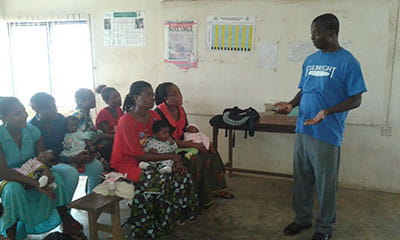
Dr. Raymond Chimezie spoke to mothers at a local health center about the importance of child immunization and breast-feeding.
Dr. Raymond Chimezie, a 2013 PhD in Public Health graduate and 2016–2017 Fulbright Scholar, has headed to his native Nigeria for 10 months to advance his dissertation research on primary healthcare. He is teaching at the Federal University of Technology, Owerri, and researching the perceptions of physicians and nurses about advanced nursing practice in the Nigerian healthcare system.
Before Dr. Chimezie focused on healthcare, he was a public school teacher in the West Contra Costa Unified School District in California. He became ill and was diagnosed with diabetes. “I started asking why I got this disease. I care about what I eat. I exercise. I don’t smoke. I don’t drink carelessly. Why do I have this condition?” he asked.
After being prescribed medication, Dr. Chimezie sought to find his way off of it as soon as possible. He decided to educate himself about the disease. Working with his doctor, he began managing his diet. After five years without the need for diabetic medication, he looked around his community and wondered if other people are suffering in silence. At this point, he decided to make a career transition to public health to help people improve their health, live well, and be happy.
“I realized if people have good education about their health, they can be part of the healing process,” he says. “That’s why I wanted to go into public health: to empower people to self-manage their health conditions. This was my calling.”
Wanting to combine his teaching skills and his new public health awareness, Dr. Chimezie sought a doctoral program that would allow him to earn his degree while continuing to make a difference in his community. “While I was at Walden, I learned a lot of things,” he says. “Apart from education, Walden gave me an authentic voice that will help me change people’s lives for the better. If I believe in something, I can say and do something about it.”
Dr. Chimezie has worked hard to positively impact those around him. He created a health and wellness initiative for elementary school children that teaches healthy habits from a young age. He found a group of students he calls health ambassadors and talked to them about nutrition and drugs, and taught them how to talk to fellow students. Ultimately, Dr. Chimezie intends to introduce this program to all schools in the West Contra Costa Unified School District when he returns from Nigeria.
Elsewhere in his community, Dr. Chimezie became an emergency responder, a volunteer at local hospitals, and a member of an advisory board at the Samuel Merritt University Ethnic Health Institute.To champion his passion for improved healthcare to minorities and rural communities, Dr. Chimezie also founded a nonprofit known as the Health for Schools and Communities Foundation.
He joined the U.S. Air Force Auxiliary as a first lieutenant and was in charge of the Drug Demand Reduction program, where he developed and implements programs for cadets about drug abuse, drug awareness, education and prevention.
“Now that I have this education and am emboldened, I believe I can carry the message of positive social change to anyplace I can possibly be,” says Dr. Chimezie. “I love that. I’m completely transformed. I’m driven to make sure I put all the resources I can to solve public health problems.”
This is the central reason why he is in Nigeria, where public health issues persist. “I come from a community where people are forgotten. No one talks about policies or why people are dying from preventable causes.”
His dissertation was a case study of a healthcare delivery system in a rural area, Isu, Nigeria. Without doctors, water, electricity or a laboratory, people were driven to self-medication, which led to complications for many.
Over the next 10 months, Dr. Chimezie says he wants to transform his Nigerian students to be active and passionate professionals—scholar-practitioners who understand the whole issue and how to find alternatives. He will also host a health festival for the local community to educate residents about healthcare.
“We need to educate students and make them new professionals who understand how to educate members of the community,” he says. “I’m so excited and happy I have this opportunity. My dream is unfolding.”