


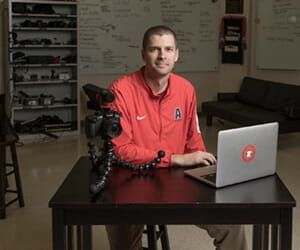
When it comes to overcoming obstacles, Adam Burns ’10, an MS in Education graduate and 2018 Outstanding Alumni Award finalist, is a pro. In his third year of teaching at Athens High School in Troy, Michigan, Burns undertook the daunting task of revamping the school’s outdated broadcasting curriculum. After he secured community funding to acquire updated technology, Burns’ class went from zero enrollments to 125 students each year.
His determination has since encouraged his students to take on their own challenges. In 2015, one student took the skills he learned in class to travel to Haiti and make a documentary about the Joan Rose Foundation, a nonprofit group that supports impoverished Haitian children. Inspired by the film, the school’s student body selected the foundation to benefit from its 2016 Charity Week and raised $84,000.
Burns shares his advice on how fellow educators can break down the walls of the traditional classroom setting to encourage real-world innovation and learning.
ENGAGE WITH THE COMMUNITY. “Your students may be afraid to reach out to local organizations for help with a project, but if they are willing to try, good usually comes of it. One of my students wanted to provide new clothing for girls in foster care, but she wasn’t sure how to start. She got in touch with Threads for Teens, a nonprofit clothing boutique in California, and convinced them to host a pop-up shop with her and a dozen volunteers to give away donated clothing to those in need. That only happened because she wasn’t afraid to ask. I always tell my students that people will want to work with you if you show a passion for what you are both doing and demonstrate how you could work together.”
EXPERIMENT WITH TECHNOLOGY. “Technology changes daily, so it’s important to stay current with new apps and tools. But don’t be afraid to admit if you’re not sure how to use something. Sometimes it’s even better to put the technology into the hands of your students and see what they can do with it. The podcast curriculum I originally taught in my class has evolved into more of a music creation studio using software that my students discovered. It’s something I had no experience with, but they tinkered with it and learned it on their own. Even if you may not see how something can have an impact in your class, your students might.”
ENCOURAGE INTERDISCIPLINARY COLLABORATION. “I personally feel that isolated school subjects are becoming irrelevant. Students need to acquire the mental agility to adapt to different fields in their future careers. That’s why it’s important to collaborate with other classes outside your own. Maybe you can study animation with an art class or discuss marketing and promotion techniques with a business class. Cross-curricular projects help students develop their creative processes and familiarize them with working on complex challenges as part of a team. Be open to facilitating those connections in your classroom.”