


Why is psychology grad Michael Wayne Hubbell ’09 working at a nuclear power plant?
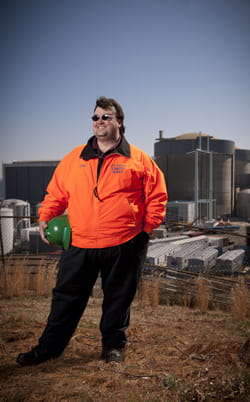
Michael Wayne Hubbell’s classroom is a nuclear power plant. His students are some of the smartest people in the industry. They work in a place where the stakes are high and the danger is real every day—especially now that all eyes are on them following the 2011 meltdown of the Fukushima Dai-ichi Nuclear Power Plant in Japan.
Hubbell, the author of The Fundamentals of Nuclear Power Generation, is the nuclear technical training instructor for Constellation Energy at Calvert Cliffs Nuclear Power Plant in Maryland. There, he counsels his colleagues on the values of stress management, communication, health, and wellness in a tense work environment.
This career path comes courtesy of his 2009 MS in Psychology degree from Walden. And while psychology and nuclear power plant operation may seem like incongruous professions, he sees the two as a natural fit. Hubbell has always questioned how things work, whether it’s the technical details of power plant operation or the complexities of the human psyche.
Consider the necessity, and urgency, of learning and memorizing complex procedures in a power plant. To help his colleagues with this task, Hubbell looks to the late German psychologist Hermann Ebbinghaus’ hypothesis on the exponential nature of forgetting. Ebbinghaus believed that the speed of forgetting depends on the difficulty of the material as well as stress and sleep.
“I focus on human behavior during normal and abnormal job duties,” Hubbell says. “My goal is to help everyone learn more about nuclear power generation. I use the knowledge I learned at Walden to ensure my peers benefit from their experiences in the classroom and online.”
Most significantly, he leverages those same skills to help his colleagues improve their lives. “Teaching in a nuclear environment allows me to use the fundamentals of psychology to help my peers retain as much information as possible,” he explains. “Sharing my knowledge helps my students become better people inside and outside of work.”
Helping and teaching others have long been passions of Hubbell’s, who has taught as an online adjunct faculty member at Bismarck State College since 2002 and also teaches nuclear principles at the College of Southern Maryland.
“Walden helped me realize my potential for changing the world,” he says. “The university has given me the freedom to become better educated and improve the conditions of the world we live in, one person at a time.”
Tell us about your career by emailing [email protected].