
View our EdD Early Childhood specialization completion requirements
Minimum degree requirements:
60 quarter credits
- Core courses (50 cr.)
- Capstone (10 cr.)
Minimum degree requirements:
60 quarter credits
Courses
In the EdD Early Childhood Education specialization, you’ll build skills and progress toward your final capstone project in every course.
Disclaimers: Walden students have up to 8 years to complete their doctoral program unless they petition for an extension.
In general, students are continuously registered in the dissertation/doctoral study course until they complete their capstone project and it is approved. This usually takes longer than the minimum required terms in the dissertation/doctoral study course shell.
To complete a doctoral dissertation, students must obtain the academic approval of several independent evaluators including their committee, the University Research Reviewer, and the Institutional Review Board; pass the Form and Style Review; gain approval at the oral defense stage; and gain final approval by the Chief Academic Officer. Students must also publish their dissertation on ProQuest before their degree is conferred. Learn more about the dissertation process in the Dissertation Guidebook.
For a personalized estimate of the number of your transfer credits that Walden would accept, call an Enrollment Specialist at 844-937-8785.
Courses
PhD completion program courses help you return to doctoral work, match with an advisor, and stay on track to finishing your dissertation.
Disclaimers: Walden students have up to 8 years to complete their doctoral program unless they petition for an extension.
In general, students are continuously registered in the dissertation/doctoral study course until they complete their capstone project and it is approved. This usually takes longer than the minimum required terms in the dissertation/doctoral study course shell.
To complete a doctoral dissertation, students must obtain the academic approval of several independent evaluators including their committee, the University Research Reviewer, and the Institutional Review Board; pass the Form and Style Review; gain approval at the oral defense stage; and gain final approval by the Chief Academic Officer. Students must also publish their dissertation on ProQuest before their degree is conferred. Learn more about the dissertation process in the Dissertation Guidebook.
For a personalized estimate of the number of your transfer credits that Walden would accept, call an Enrollment Specialist at 844-937-8785.
Courses
Develop the skills and confidence you need to tackle complex managerial challenges, contribute new knowledge, or teach at the graduate level.
Courses
Develop the skills and confidence needed for complex managerial challenges and research with Walden’s ACBSP-accredited PhD program.
Discover career opportunities in your area that match your interests.
Iris Yob began her career in education as an elementary school teacher in Australia. She went on to earn her Ed.D. in the philosophy of education from Harvard University, where she studied the languages of music and spirituality. “The question that was driving me was, ‘How can we make education really meaningful?’” she says. While working at Indiana University, she was invited to attend a Walden University commencement. Impressed by the KAM model of learning and intrigued by Walden’s “forward looking, student-centered approach,” Yob began teaching at Walden in 1997. Now, as associate director for Walden’s Center for Teaching and Learning, Yob’s focus is in part on maximizing the value of the KAM model of learning.
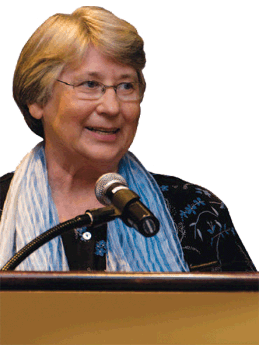
Let’s start with the million-dollar question: What is a KAM? KAM stands for “Knowledge Area Module.” A KAM is a guided independent study that takes doctoral students in select programs through theory and research to practice, in the context of a long paper related to the student’s interests.
What was the impetus behind Walden’s introduction of the KAM model in 1986? The KAM model fits in with the progressive education outlook of the university—giving the students control over their learning and learning by doing. And the structure of the KAM was influenced by Walden’s social change mission: learning in order to bring about change.
As the author of Walden’s guide to KAMs, what is the greatest benefit to the KAM model? KAMs help students address issues of concern in their professional lives and develop critical and creative thinking skills, so they’re better equipped to go out and make social change in their fields. It gives adult learners the skills and confidence they need to do the biggest project of all—the dissertation.
What are the components of a KAM? A KAM paper comprises three parts: theory, research, and application. First, students look at various theories around whatever the topic is. Then they look for research that relates to the theory and connects the theory to their own interests. Finally, the theory and research parts inform some kind of practical project that relates directly to their work.
How do you grade a KAM? We have a rubric that we use to judge them and it has dozens of small points, and each one has to be graded on a five-point scale. We’re going to use a grant from the Laureate Higher Education Group to look at the factors that contribute to effectiveness in assessment. —Deirdre Schwiesow
Download Dr. Iris Yob's “A Guide to the Knowledge Area Modules: Making the KAMs Work for You.” (PDF)
Fill out the form and we will contact you to provide information about furthering your education.
Please use our International Form if you live outside of the U.S.
Walden University is accredited by the Higher Learning Commission (www.hlcommission.org), an institutional accreditation agency recognized by the U.S. Department of Education.
Walden University is a member of Adtalem Global Education, Inc. www.adtalem.com | Walden University is certified to operate by SCHEV
© 2026 Walden University LLC. All rights reserved.
Legal & Consumer Info | Website Terms and Conditions | Cookie Policy